<?xml version="1.0" encoding="utf-8"?><feed xmlns="http://www.w3.org/2005/Atom" ><generator uri="https://jekyllrb.com/" version="4.4.1">Jekyll</generator><link href="https://www.noreastergroup.com/feed.xml" rel="self" type="application/atom+xml" /><link href="https://www.noreastergroup.com/" rel="alternate" type="text/html" /><updated>2026-11-10T16:50:41+00:00</updated><id>https://www.noreastergroup.com/feed.xml</id><title type="html">Noreaster Group</title><subtitle>Noreaster Group is a software development company that specializes in building custom software solutions for businesses.</subtitle><entry><title type="html">Why WordPress Is Hard to Manage (and What to Do About It)</title><link href="https://www.noreastergroup.com/blog/2026/10/16/why-wordpress-is-hard-to-manage/" rel="alternate" type="text/html" title="Why WordPress Is Hard to Manage (and What to Do About It)" /><published>2026-10-16T13:00:00+00:00</published><updated>2026-10-16T13:00:00+00:00</updated><id>https://www.noreastergroup.com/blog/2026/10/16/why-wordpress-is-hard-to-manage</id><content type="html" xml:base="https://www.noreastergroup.com/blog/2026/10/16/why-wordpress-is-hard-to-manage/"><![CDATA[<p>WordPress isn’t hard to launch. It’s hard to own.</p>

<p>As of October 2026, W3Techs puts WordPress on 40.2% of all websites and 58.7% of sites with an identifiable CMS. The next-closest platform, Shopify, sits at 5.4%. That’s an enormous community: tens of thousands of free plugins, a deep bench of developers, and a host on every corner.</p>

<p>But that same popularity has a quiet cost. Most WordPress sites we see at small and mid-sized companies weren’t built to be maintained. They were built to launch. Somebody (an agency, a freelancer, a nephew) set it up, installed a dozen plugins, handed over a login, and moved on. Two or three years later, nobody knows what’s installed, what’s out of date, or who’s responsible when something breaks.</p>

<p>That gap between “easy to start” and “hard to run” is where security risk, editorial frustration, and surprise invoices live. Here’s why, and what to do about it.</p>

<h2 id="the-update-treadmill-nobody-signed-up-for">The update treadmill nobody signed up for</h2>

<p>A typical WordPress site isn’t one piece of software. It’s WordPress core, a theme, a page builder, and a stack of plugins from a dozen different vendors, all running on a PHP version your host may or may not keep current. Each piece ships updates on its own schedule, and any one of them can break the others.</p>

<p>That’s why so many sites fall behind. The reasons are rarely negligence. They’re structural:</p>

<ul>
  <li><strong>No clear owner.</strong> The person who built the site is gone, and “keep the website updated” isn’t in anyone’s job description.</li>
  <li><strong>Fear of breaking things.</strong> Clicking “Update All” on a live site with no staging copy and no backup feels like defusing a bomb. So people don’t.</li>
  <li><strong>Lapsed licenses.</strong> Premium themes and plugins usually stop receiving updates when the annual license expires. The site keeps working, quietly frozen in time.</li>
  <li><strong>Abandoned plugins.</strong> Some plugins simply stop being maintained. Nothing warns you; the updates just stop coming.</li>
</ul>

<p>Even sites that do update are often a version behind. W3Techs’ October 2026 data shows 63.8% of WordPress sites on the current 7.x line and 29.1% still on 6.x, with the rest on older releases. Core is the easy part, too. The real exposure is everything bolted onto it.</p>

<h2 id="what-the-security-data-actually-says">What the security data actually says</h2>

<p>The numbers from Patchstack’s <a href="https://patchstack.com/whitepaper/state-of-wordpress-security-in-2026/">State of WordPress Security in 2026</a> report are worth sitting with:</p>

<table>
  <thead>
    <tr>
      <th>Finding (2025 data)</th>
      <th>Number</th>
    </tr>
  </thead>
  <tbody>
    <tr>
      <td>New vulnerabilities found in the WordPress ecosystem</td>
      <td>11,334 (up 42% from 2024)</td>
    </tr>
    <tr>
      <td>Share found in plugins</td>
      <td>91% (themes: 9%)</td>
    </tr>
    <tr>
      <td>Vulnerabilities found in WordPress core</td>
      <td>6, all low priority</td>
    </tr>
    <tr>
      <td>Vulnerabilities with no fix by public disclosure</td>
      <td>46%</td>
    </tr>
    <tr>
      <td>Median time to mass exploitation, heavily exploited flaws</td>
      <td>5 hours</td>
    </tr>
    <tr>
      <td>Attacks blocked by typical hosting defenses (pentest)</td>
      <td>26%</td>
    </tr>
  </tbody>
</table>

<p>Read that table again with your own site in mind. WordPress core is in good shape. The risk lives almost entirely in the plugins and themes you added, and attackers move in hours, not weeks.</p>

<p>Two findings matter most for neglected sites. First, attackers don’t just chase new flaws. Of the ten vulnerabilities Patchstack saw targeted most in 2025, only four were published that year; the rest were older bugs, still working because sites never updated. Second, paying for a plugin doesn’t buy safety. Patchstack found premium components carried three times as many known exploited vulnerabilities as free ones.</p>

<p>And a breach isn’t always obvious. Common malware families serve clean pages to the site owner and spam or phishing redirects to everyone else. Many businesses find out from a customer, a Google warning, or a sudden drop in search traffic.</p>

<div class="bg-primary rounded-2xl p-8 sm:p-10 my-10 text-center text-white">
  <h3 class="font-serif text-2xl sm:text-3xl font-bold !mt-0 mb-3 !text-white">Not sure where your WordPress site stands?</h3>
  <p class="text-white mb-6 max-w-xl mx-auto leading-relaxed">
    Noreaster Group can help you take stock of your plugins, hosting, and risk, and map out whether to maintain, simplify, or rebuild.
  </p>
  <a href="/contact/" class="btn-secondary !no-underline">Set up a call with us</a>
</div>

<h2 id="editing-content-shouldnt-require-a-support-ticket">Editing content shouldn’t require a support ticket</h2>

<p>Security is the scary half of the story. The everyday half is that a lot of teams simply dread updating their own website.</p>

<p>To be fair, the WordPress block editor (Gutenberg) has come a long way since 2018. But on a typical business site, editors aren’t using “WordPress.” They’re using whatever combination of theme, page builder, and custom fields someone assembled years ago. Elementor alone runs on roughly a third of WordPress sites, layered on top of the native editor. The result is three ways to edit a page, layouts that break when you paste in a paragraph, and a quiet rule that only one person is allowed to touch the homepage.</p>

<p>The broader CMS market has moved in a different direction:</p>

<table>
  <thead>
    <tr>
      <th>Approach</th>
      <th>Examples</th>
      <th>Who maintains the software</th>
      <th>Editing experience</th>
      <th>Trade-off</th>
    </tr>
  </thead>
  <tbody>
    <tr>
      <td>Self-hosted WordPress</td>
      <td>WordPress + theme + plugins</td>
      <td>You (or whoever you pay)</td>
      <td>Depends entirely on how it was built</td>
      <td>Maximum flexibility, maximum upkeep</td>
    </tr>
    <tr>
      <td>Hosted site builders</td>
      <td>Squarespace, Wix, Webflow</td>
      <td>The vendor</td>
      <td>Visual, consistent, guardrails built in</td>
      <td>Less flexibility; you live inside their platform</td>
    </tr>
    <tr>
      <td>Structured / headless CMS</td>
      <td>Sanity, Contentful, Strapi</td>
      <td>The vendor (or a small, defined codebase)</td>
      <td>Content is separated from layout, so editors can’t break the design</td>
      <td>Needs developer setup up front</td>
    </tr>
  </tbody>
</table>

<p>None of these is right for everyone. But it’s worth noticing that the competition largely sells the thing WordPress leaves to you: someone else owns the updates, and editors get guardrails instead of a blank canvas.</p>

<h2 id="why-the-moat-is-thinner-than-it-looks">Why the moat is thinner than it looks</h2>

<p>WordPress’s moat has always been its community: the plugins, the themes, the developers, the hosts. That’s real, and it isn’t going away. But a moat built on an ecosystem only holds if someone is minding the ecosystem, and on most business sites, nobody is.</p>

<p>WordPress is open source, which is a strength. It also means there’s no single company accountable for your site. The core team ships core. Thousands of independent vendors ship plugins of wildly varying quality. Your host keeps the server running. Everything in between, including the decisions about what to update, what to remove, and what to do when two plugins collide, lands on you.</p>

<p>The leadership of the project itself hasn’t been a picture of calm, either. In 2024, a public feud between Automattic CEO Matt Mullenweg and hosting company WP Engine escalated to WP Engine being cut off from WordPress.org and a popular plugin, Advanced Custom Fields, being forked out from under its developers. WP Engine <a href="https://techcrunch.com/2024/10/18/wp-engine-files-an-injuction-to-get-its-wordpress-org-access-back">sued and sought an injunction</a>; a federal judge <a href="https://websightdesign.com/blog/web-development/the-wordpress-vs-wp-engine-saga-continues-what-happened-next">ordered its access restored</a> in December 2024, and the <a href="https://wpengine.com/blog/ensuring-stability-and-security/">litigation</a> is still working its way through the courts in 2026. For a business owner, the lesson isn’t about who’s right. It’s that even infrastructure everyone depends on can be disrupted by people you’ll never meet.</p>

<p>Meanwhile, W3Techs’ numbers have started to drift. WordPress held steady around 43% of the web from 2022 through early 2026, and it’s at 40.2% as of October. It’s still dominant by a mile, and nobody can say for sure why the share is slipping. But hosted builders and structured CMS platforms are winning customers with a simple pitch: we’ll handle the parts WordPress hands to you.</p>

<h2 id="what-to-do-about-it-maintain-simplify-or-move">What to do about it: maintain, simplify, or move</h2>

<p>Start with the same four steps no matter where you end up:</p>

<ol>
  <li><strong>Take inventory.</strong> List every plugin and theme, when it was last updated, and whether its license is current. Delete anything inactive; a deactivated plugin can still be a liability.</li>
  <li><strong>Get on managed WordPress hosting.</strong> If you’re on generic shared hosting or a general-purpose cloud box, move. Hosts built specifically for WordPress, like WP Engine, SiteGround, and DreamHost’s DreamPress, patch PHP and server-level vulnerabilities themselves, often within hours of disclosure, instead of leaving it to you or a host that may never touch it. Most also bundle the safety net every site needs regardless: automated off-site backups and a staging copy, so updates can be tested before they hit the live site.</li>
  <li><strong>Name an owner.</strong> One person or partner is accountable for updates, with a regular cadence on the calendar.</li>
  <li><strong>Don’t rely on updates alone.</strong> With 46% of vulnerabilities still unpatched at disclosure and exploitation measured in hours, sites that matter need monitoring and a security layer that can block attacks before a fix ships.</li>
</ol>

<p>Then make an honest call about the platform itself:</p>

<table>
  <thead>
    <tr>
      <th>Path</th>
      <th>Right when</th>
      <th>What it takes</th>
    </tr>
  </thead>
  <tbody>
    <tr>
      <td>Maintain WordPress properly</td>
      <td>The site is heavily customized, drives real business, and your team is comfortable editing it</td>
      <td>A standing maintenance budget and an accountable technical partner</td>
    </tr>
    <tr>
      <td>Simplify onto a hosted builder</td>
      <td>It’s mainly a brochure site: a handful of pages, a contact form, few integrations</td>
      <td>A one-time migration; the vendor handles updates from then on</td>
    </tr>
    <tr>
      <td>Rebuild on a structured CMS or custom app</td>
      <td>Content is complex, or the “website” is really a product: customer logins, bookings, payments, integrations</td>
      <td>A real build, scoped like software, with someone who will own it after launch</td>
    </tr>
  </tbody>
</table>

<p>One more judgment call cuts across all three paths: not every feature belongs on WordPress just because a plugin exists for it. WordPress is close to infinitely customizable, which is exactly the trap. It’s tempting to bolt on a plugin for anything, when a tool built for that one job would do it better, with none of the update burden.</p>

<ul>
  <li><strong>Selling products?</strong> WooCommerce can work, but it’s also one of the most plugin-dependent, frequently-patched corners of the WordPress ecosystem. Shopify is purpose-built for exactly this job and carries none of that weight.</li>
  <li><strong>Running a newsletter?</strong> A newsletter plugin is one more thing to keep updated on your site. Substack or a dedicated email platform handles delivery, deliverability, and subscriber management without touching WordPress at all.</li>
  <li><strong>Taking bookings or payments?</strong> The same logic applies. A dedicated scheduling or payments tool is usually safer and simpler than a general-purpose plugin trying to do it from inside WordPress.</li>
</ul>

<p>The pattern: the more a feature touches money, customer data, or compliance, the more it’s worth asking whether it needs to live inside WordPress at all.</p>

<p>The worst option is the most common one: doing nothing and hoping the site stays quiet.</p>

<h2 id="the-bottom-line">The bottom line</h2>

<p>WordPress earned its 40% of the web. But popularity isn’t the same as being looked after, and a website nobody owns is a liability with your logo on it.</p>

<p>At Noreaster Group, we’ve spent our careers inside companies like HubSpot and Dockwa, where the website and the product had to keep working long after launch day. We help teams across Maine and New England figure out which path fits: when WordPress is worth maintaining, when it’s time to simplify, and when the “website” has quietly become software that deserves to be built like it.</p>

<p><strong>If this sounds like your site, let’s talk.</strong> We’ll look at your plugins, core version, hosting, and the platform decision itself, and tell you plainly what’s a risk, what’s wasted spend, and what to fix first.</p>

<div class="bg-primary rounded-2xl p-8 sm:p-10 my-10 text-center text-white">
  <h3 class="font-serif text-2xl sm:text-3xl font-bold !mt-0 mb-3 !text-white">Not sure where your WordPress site stands?</h3>
  <p class="text-white mb-6 max-w-xl mx-auto leading-relaxed">
    Noreaster Group can help you take stock of your plugins, hosting, and risk, and map out whether to maintain, simplify, or rebuild.
  </p>
  <a href="/contact/" class="btn-secondary !no-underline">Set up a call with us</a>
</div>

<h2 id="sources">Sources</h2>

<ul>
  <li>Patchstack, <a href="https://patchstack.com/whitepaper/state-of-wordpress-security-in-2026/">State of WordPress Security in 2026</a> (February 2026)</li>
  <li>eSEOspace, <a href="https://eseospace.com/blog/wordpress-market-share-2026/">WordPress Market Share in 2026</a>, summarizing W3Techs data as of October 1, 2026</li>
  <li>TechCrunch, <a href="https://techcrunch.com/2024/10/18/wp-engine-files-an-injuction-to-get-its-wordpress-org-access-back">WP Engine files an injunction to get its WordPress.org access back</a> (October 2024)</li>
  <li>WebSight Design, <a href="https://websightdesign.com/blog/web-development/the-wordpress-vs-wp-engine-saga-continues-what-happened-next">The WordPress vs. WP Engine Saga Continues</a> (June 2026)</li>
  <li>WP Engine, <a href="https://wpengine.com/blog/ensuring-stability-and-security/">Legal actions against Matt Mullenweg and Automattic</a></li>
</ul>]]></content><author><name>Adrian</name></author><category term="security" /><summary type="html"><![CDATA[WordPress powers 40% of the web, but most business sites were built to launch, not to be maintained. Here's what the 2026 security data says, and how to decide whether to maintain, simplify, or rebuild.]]></summary></entry><entry><title type="html">From Wanderlust to Word of Mouth: The Five Phases of Travel as a Flywheel</title><link href="https://www.noreastergroup.com/blog/2026/10/12/from-wanderlust-to-word-of-mouth/" rel="alternate" type="text/html" title="From Wanderlust to Word of Mouth: The Five Phases of Travel as a Flywheel" /><published>2026-10-12T13:00:00+00:00</published><updated>2026-10-12T13:00:00+00:00</updated><id>https://www.noreastergroup.com/blog/2026/10/12/from-wanderlust-to-word-of-mouth</id><content type="html" xml:base="https://www.noreastergroup.com/blog/2026/10/12/from-wanderlust-to-word-of-mouth/"><![CDATA[<p>The best customer journeys don’t end at the purchase or sale. They loop back and start the next one.</p>

<p>When we were building Dockwa, we spent a lot of time with a simple model Google popularized: the five phases of travel.</p>

<p>Every trip moves through dreaming, planning, booking, experiencing, and reflecting. It’s a useful map. But the more we worked with it, the less it looked like a line and the more it looked like a flywheel.</p>

<p>That shift, from funnel to flywheel, changed how we thought about growth. And it applies well beyond travel.</p>

<ol>
  <li><strong>Dreaming.</strong> Something sparks the idea of a trip: a friend’s photos, a story, a picture of a harbor at sunset. The traveler isn’t shopping yet. They’re imagining.</li>
  <li><strong>Planning.</strong> The dream gets practical. Where exactly, when, how much, and what are the options? This is research, comparison, and a lot of open browser tabs.</li>
  <li><strong>Booking.</strong> The traveler commits. Price, availability, and trust all have to line up at the same moment.</li>
  <li><strong>Experiencing.</strong> The trip itself. This is where the promise made during dreaming either holds up or doesn’t.</li>
  <li><strong>Reflecting.</strong> The traveler comes home and tells the story: photos, posts, reviews, and recommendations to friends.</li>
</ol>

<p>Read top to bottom, it looks like a funnel. reflecting is the last step, the nice ending after the real work is done. That reading misses the most valuable part.</p>

<h2 id="from-funnel-to-flywheel">From funnel to flywheel</h2>

<p>In a flywheel, reflecting isn’t the end. It’s the fuel for the next turn. Each stage hands momentum to the next:</p>

<ul>
  <li><strong>Dreaming → planning.</strong> Inspiration becomes intent. The traveler has a “where” and starts asking “how.” The job is to catch that shift before the intent drifts to a search engine or a competitor.</li>
  <li><strong>Planning → booking.</strong> Research becomes confidence. Reviews and stories from past travelers do the heavy lifting here, because peers are more believable than anything a business says about itself.</li>
  <li><strong>Booking → experiencing.</strong> A transaction becomes a real trip. Any gap between what was promised and what’s delivered sets the tone for everything shared afterward.</li>
  <li><strong>Experiencing → reflecting.</strong> The trip becomes a story. The best time to capture it is during the trip or right after, while the feeling is fresh. Wait a week and the photos stay on the camera roll.</li>
  <li><strong>Reflecting → dreaming.</strong> This is the loop that matters. One traveler’s photos, reviews, and recommendations become the spark for someone else’s dream.</li>
</ul>

<p>User-generated content is what closes the loop. At Dockwa, a boater’s review of a harbor or a photo of a mooring field at sunset was exactly the thing that got another boater to pick that destination next season. The same content then helped them plan and book with confidence.</p>

<p>That’s the flywheel effect: every completed trip produces fuel for future trips. As the base of content grows, inspiring the next traveler gets cheaper, not more expensive.</p>

<div class="bg-primary rounded-2xl p-8 sm:p-10 my-10 text-center text-white">
  <h3 class="font-serif text-2xl sm:text-3xl font-bold !mt-0 mb-3 !text-white">Want your growth loop to actually spin?</h3>
  <p class="text-white mb-6 max-w-xl mx-auto leading-relaxed">
    We've built marketing and product-led growth motions at companies like HubSpot and Dockwa. Noreaster Group can help you turn your customers' experience into the content and distribution that wins the next one.
  </p>
  <a href="/contact/" class="btn-secondary !no-underline">Set up a call with us</a>
</div>

<h2 id="beyond-travel-the-customer-purchasing-flywheel">Beyond travel: the customer purchasing flywheel</h2>

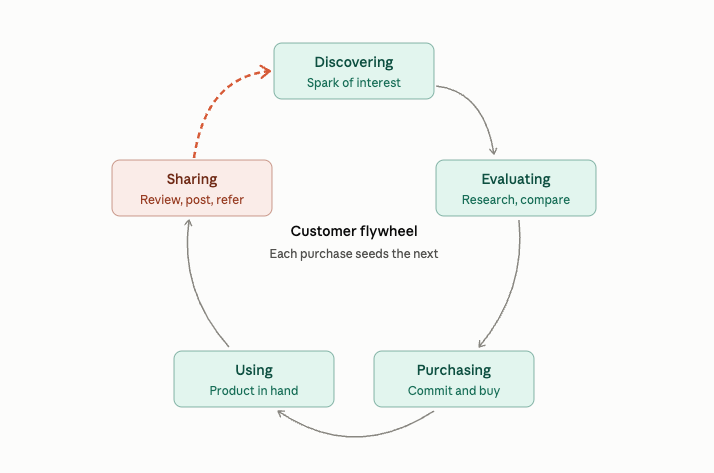
<p>Swap “trip” for “purchase” and the same model describes almost any buyer’s journey, from a pair of boots to a piece of business software.</p>

<table>
  <thead>
    <tr>
      <th>Travel stage</th>
      <th>Buyer stage</th>
      <th>What the buyer is doing</th>
    </tr>
  </thead>
  <tbody>
    <tr>
      <td>Dreaming</td>
      <td>Discovering</td>
      <td>Noticing a want or a problem, often sparked by someone else’s post, recommendation, or review</td>
    </tr>
    <tr>
      <td>Planning</td>
      <td>Evaluating</td>
      <td>Researching options, comparing, and looking for proof that people like them got what they wanted</td>
    </tr>
    <tr>
      <td>Booking</td>
      <td>Purchasing</td>
      <td>Committing, once price, timing, and trust line up</td>
    </tr>
    <tr>
      <td>Experiencing</td>
      <td>Using</td>
      <td>Unboxing, onboarding, and finding out whether the product delivers</td>
    </tr>
    <tr>
      <td>reflecting</td>
      <td>reflecting</td>
      <td>Reviewing, posting, and recommending it to others</td>
    </tr>
  </tbody>
</table>

<p>The handoffs work the same way. Discovery turns into active evaluation. Peer reviews and real customer stories turn evaluation into a confident purchase. The first experience with the product decides whether the customer becomes a fan or a cautionary tale. And a happy customer’s review, post, or referral becomes the next buyer’s moment of discovery, and the trust signal that carries them through evaluation.</p>

<p>A funnel treats the sale as the finish line. A flywheel treats it as the start of the next sale.</p>

<p><img src="/assets/images/blog/customer-journey-flywheel.png" alt="The customer purchasing flywheel: discovering, evaluating, purchasing, using, and reflecting" /></p>

<h2 id="what-makes-the-flywheel-actually-spin">What makes the flywheel actually spin</h2>

<p>Drawing the circle is easy. Getting it to turn takes two things most companies only half do.</p>

<p><strong>Deliver a customer experience worth talking about.</strong> Everything else in this flywheel rests on this. If the product, service, or destination doesn’t live up to its promise, the loop runs in reverse. The reviews turn lukewarm or negative, the photos never get posted, and the content that should be inspiring the next customer warns them off instead. No prompt or placement strategy can fix that. Before optimizing any other stage, make sure the experience itself is one people want to share.
With that foundation in place, two more things determine how fast the wheel spins, and most companies only half do them.</p>

<p><strong>Make reflecting effortless and well timed.</strong> Ask for the review, photo, or referral right after a moment of value: the end of a great stay, the first win with a new tool, the unboxing. Build the prompt into the product so it’s one tap, not a chore. The longer the gap between the experience and the ask, the less you get.</p>

<p><strong>Put that content where new buyers are discovering and evaluating.</strong> This is the step that gets skipped. Plenty of companies collect reviews and then bury them on a page nobody visits. Customer content only closes the loop when it shows up in search results, on listing pages, in social feeds, and at the moment of decision.</p>

<p>Get both right and each customer makes the next one easier to win. Miss either and you’re back to a funnel, paying full price to fill the top every single time.</p>

<h2 id="the-takeaway">The takeaway</h2>

<p>Google’s five stages of travel gave us a clear map of how people move from “wouldn’t it be nice” to “we’re going.” Turning that map into a loop is what makes it a growth model. Whether you’re selling slips at a marina or software to a small business, ask one question of every stage: how does this customer help bring us the next one?</p>

<div class="bg-primary rounded-2xl p-8 sm:p-10 my-10 text-center text-white">
  <h3 class="font-serif text-2xl sm:text-3xl font-bold !mt-0 mb-3 !text-white">Ready to put your growth flywheel to work?</h3>
  <p class="text-white mb-6 max-w-xl mx-auto leading-relaxed">
    At Noreaster Group, we bring together marketing and product-led growth experience from companies like HubSpot and Dockwa to help you close the loop between customers and growth.
  </p>
  <a href="/contact/" class="btn-secondary !no-underline">Set up a call with us</a>
</div>]]></content><author><name>Adrian</name></author><category term="growth" /><summary type="html"><![CDATA[Google's five stages of travel look like a funnel, but the most valuable stage comes last: reflecting, which fuels the next traveler's dream. Here's how that flywheel applies far beyond travel.]]></summary></entry><entry><title type="html">Welcome to the Noreaster Group Blog</title><link href="https://www.noreastergroup.com/blog/2026/10/08/welcome-to-the-noreaster-blog/" rel="alternate" type="text/html" title="Welcome to the Noreaster Group Blog" /><published>2026-10-08T13:00:00+00:00</published><updated>2026-10-08T13:00:00+00:00</updated><id>https://www.noreastergroup.com/blog/2026/10/08/welcome-to-the-noreaster-blog</id><content type="html" xml:base="https://www.noreastergroup.com/blog/2026/10/08/welcome-to-the-noreaster-blog/"><![CDATA[<p>We work with founders and teams building real products, and along the way we pick up things worth sharing: lessons from shipping, patterns that hold up in production, and tools that are actually worth adopting.</p>

<p>This blog is where we’ll write those notes down.</p>

<h2 id="what-to-expect">What to expect</h2>

<ul>
  <li>Field notes from client engagements (with details changed to protect confidentiality)</li>
  <li>Practical takes on AI-assisted development, from prototype to production</li>
  <li>Deep dives on the tools and architecture decisions we keep coming back to</li>
</ul>

<p>If you want the short version as it happens, follow along via <a href="/feed.xml">RSS</a> or <a href="https://www.linkedin.com/company/noreaster-group">LinkedIn</a>. Otherwise, we’ll see you back here.</p>]]></content><author><name>Noreaster Group</name></author><category term="announcements" /><summary type="html"><![CDATA[We're kicking off a blog to share what we're learning while building software, shipping products, and working with AI.]]></summary></entry></feed>